
PFAS Testing in Food: Optimizing Sample Preparation with QuEChERS
Based on U.S. FDA Research
The emerging contaminants known as PFAS (Per- and Polyfluoroalkyl Substances) are a large class of synthetic fluorinated aliphatic compounds, widely used in industrial and consumer products since the 1950s. PFAS are highly stable, persistent, and resistant to environmental degradation, earning them the nickname “forever chemicals.” Recent studies show that PFAS are commonly detected in water, soil, and the food safety, posing a range of risks to human health.
Table of Contents
Why are PFAS the New Focus of Food Safety?
How Do PFAS Get into Food?
International Regulations and Standards for PFAS in Food
Challenges and Solutions for PFAS Detection in Food
Steps for PFAS Detection in Food
How to Avoid Hidden Contamination in Food PFAS Testing?
Frequently Asked Questions (FAQ)
Why are PFAS the New Focus of Food Safety?
PFAS (Per- and polyfluoroalkyl substances) are endocrine-disrupting chemicals and have been linked to various health risks, including reduced immune system function, reproductive and developmental effects, increased cholesterol levels, and increased cancer risks. The main sources of human exposure to PFAS include drinking water and food intake. Therefore, in addition to water quality monitoring, food surveillance has become a key global concern.
International bodies are actively monitoring PFAS in food and conducting risk assessments. For example, the U.S. FDA has continuously tested since 2019 and detected PFAS in various food samples, including seafood, meat, dairy products, and produce; the European Food Safety Authority (EFSA) also conducted a risk assessment on PFAS in food in 2020.
Further Reading: PFAS Testing and Removal Strategies in Water Sample Analysis
How Do PFAS Get into Food?
There are two main pathways for PFAS to enter food: environmental accumulation and food-contact materials.
- Bioaccumulation in the Food Chain: PFAS can enter crops, animal feed, meat, and aquatic products through contaminated environments, water, or biosolids. Due to their bioaccumulative nature, the concentration of PFAS is relatively higher in fish and aquatic products, especially in filter feeders like clams, oysters, and mussels.
- Food Contact Materials (FCM): Due to their oil- and water-repellent properties, PFAS are often used as grease-proofers in food packaging materials, such as paper bags, boxes, and cups. These chemicals can potentially migrate from the packaging material into the food.
Food packaging materials have now become a global regulatory focus. For instance, the European Union has listed PFAS as a critical management priority for Food Contact Materials (FCM) and packaging, gradually restricting PFAS-containing food packaging; the U.S. FDA announced that all PFAS grease-proofing agents used for food-contact purposes are no longer being sold in the U.S. market as of February 2024.
International Regulations and Standards for PFAS in Food
EU Regulation (EU) 2023/915 sets maximum levels (MLs) for four main PFAS (PFOS, PFOA, PFNA, PFHxS) in specific foodstuffs, such as fish, crustaceans, bivalve molluscs, eggs, and meat. These MLs were originally introduced by Commission Regulation (EU) 2022/2388 and became applicable starting January, 2023.
Maximum Levels of PFAS in EU Regulation (EU) 2023/915:
EU 2023/915 Regulation | Maximum Level (µg/kg) | |||||
|---|---|---|---|---|---|---|
PerfluoroalkyI substances | PFOS | PFOA | PFNA | PFHxS | Sum | |
| Meat and Edible Offal | Meat: bovine, pig, poultry | 0.3 | 0.8 | 0.2 | 0.2 | 1.3 |
Meat: sheep | 1 | 0.2 | 0.2 | 0.2 | 1.6 | |
Offal: bovine, sheep, pig, poultry | 6 | 0.7 | 0.4 | 0.5 | 8 | |
Meat: game except bear | 5 | 3.5 | 1.5 | 0.6 | 9 | |
Offal: game except bear | 50 | 25 | 45 | 3 | 50 | |
| Fishery Products & Bivalve Mollusks | Muscle meat: fish except below | 2 | 0.2 | 0.5 | 0.2 | 2 |
Muscle meat*: | 7 | 1 | 2.5 | 0.2 | 8 | |
Muscle meat*: anchovy, babel, bream, char, eel, pike-perch, perch, roach, smelt, whitefish | 35 | 8 | 8 | 1.5 | 45 | |
Crustacean and bivalve mollusks | 3 | 0.7 | 1 | 1.5 | 5 | |
| Eggs | Chicken eggs | 1 | 0.3 | 0.7 | 0.3 | 1.7 |
▲Source: “Agilent, Global PFAS Regulations, Guidance, and Regulatory Methods”
* Except for infants and young children
Other than the European Union (EU), the United States federal regulation currently has no formally unified maximum residue limits for PFAS in food.
Challenges and Solutions for PFAS Detection in Food
PFAS analysis in food is highly challenging due to the complexity of food matrices (rich in lipids, proteins, carbohydrates, pigments, etc.) and the need for extremely low concentration detection (ppb, ppt levels). Based on U.S. FDA research methods (e.g., C-010.03), QuEChERS has been used as an effective sample preparation approach to reduce the matrix effect.
QuEChERS offers multiple advantages: simplified, fast procedure, low solvent usage, and good reproducibility across various matrices. However, when dealing with complex foods or requiring extremely low limits of quantification, basic QuEChERS extraction often requires additional clean-up step. The FDA method suggests using a Weak Anion Exchange (WAX) SPE cartridge for further purification to ensure the required recovery and sensitivity for both long- and short-chain PFAS.
- Advantages of QuEChERS
- Fast and Versatile: The process is fast and simplified, suitable for various complex food matrices, especially fruits, vegetables, meat, and aquatic products.
- Efficient Clean-up: Combines liquid-liquid extraction and dispersive Solid Phase Extraction (dSPE) techniques, which help remove interferences like fat and pigments.
- Low Consumables/Solvent: Compared to traditional methods, QuEChERS saves solvent and is easier to operate.
The QuEChERS Vortex Solution to Replace Manual Shaking
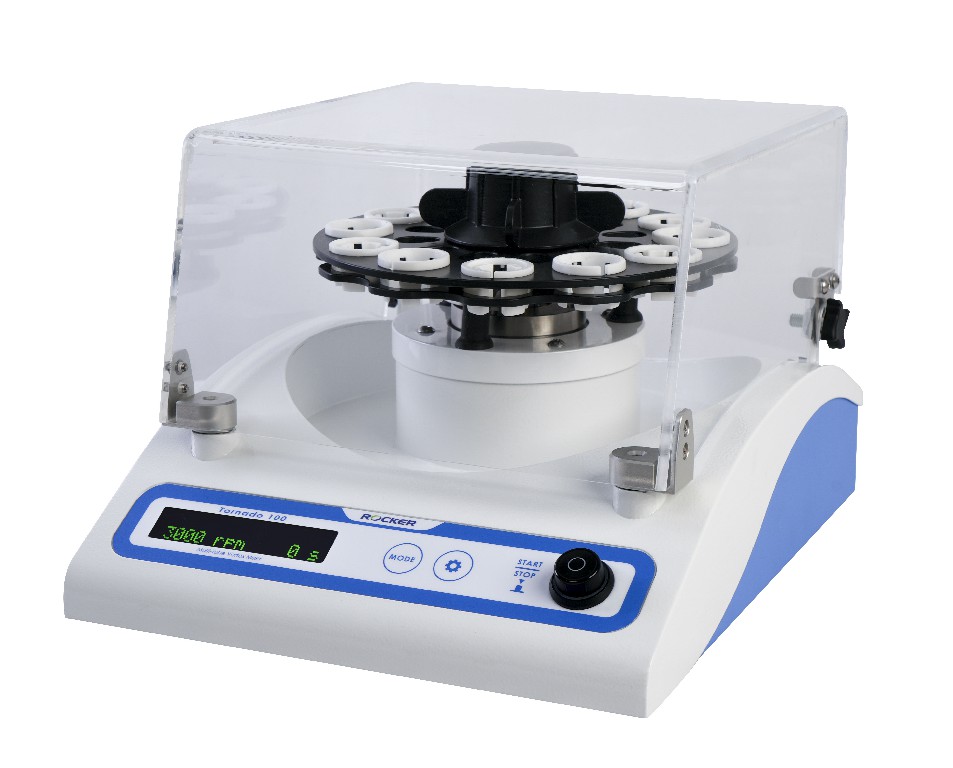
ROCKER Tornado 100 Multi-Tube Vortex Mixer
- Innovative 3D high-speed vortexing ensures thorough and uniform sample mixing
- Compatible with both 15 mL and 50 mL QuEChERS centrifuge tubes
- Dual operation modes (continuous/intermittent) for flexible use
- Saves up to 80% of space with no displacement issues
- Safety lid with auto-stop function—improves protection, prevents splashing, and enhances operational safety
Further Reading: QuEChERS

Steps for PFAS Detection in Food
PFAS analysis in food usually references specific analytical methods like U.S. FDA C-010.03, USDA CLG-PFAS 2.04, and international guidelines and performance requirements such as AOAC SMPR 2023.003 and EU Recommendation EU 2022/1431. Taking the U.S. FDA Method C-010.03, “Determination of 30 Per and Polyfluoroalkyl Substances (PFAS) in Food and Feed using Liquid Chromatography-Tandem Mass Spectrometry (LC-MS/MS),” as an example, PFAS detection in food primarily involves 5 major steps:
1. Sample Homogenization
Use a homogenizer or grinder to break up the sample, ensuring homogeneity and improving extraction efficiency and representativeness. It is recommended to use Polypropylene (PP) containers and avoid any PTFE or other fluorinated containers. Immediately after homogenization, add the isotopically labeled surrogate standards, resulting in a final extract concentration of approximately 1 ng/mL to correct for recovery and matrix effects.
2.QuEChERS Extraction
Use acetonitrile, formic acid, and the QuEChERS salt packet (MgSO4/NaCl) to extract PFAS. Shake (vortex) vigorously for extraction. After centrifugation, transfer the supernatant to a 15 mL centrifuge tube containing d-SPE sorbent, vortex and centrifuge again to remove co-extractives.
* For dry or low-moisture samples, water must be added after homogenization to rehydrate the sample, ensuring efficient QuEChERS extraction.
3.SPE Clean-up
Filter the supernatant using a 0.2 µm nylon syringe filter, then further purify using a Weak Anion Exchange (WAX) SPE cartridge to remove residual matrix components such as fats and pigments.
* SPE Cartridge: Phenomenex Strata™-XL-AW 100 µm Polymeric Weak Anion 200 mg/6 mL is recommended.
Further Reading: Solid Phase Extraction (SPE)
4.Concentration and Reconstitution
Concentrate the extract using a nitrogen evaporator at 60°C. Reconstitute the residue with methanol and add the Isotopically Labeled Internal Standard (NIS). Filter with a 0.2 µm nylon syringe filter, preparing for LC-MS/MS analysis.
5.Analysis and Quantification
Select an appropriate column for PFAS analysis (Waters XBridge C18, 150 mm x 2.1 mm, 3.5 µm is recommended) to ensure separation efficiency and resolution, and perform analysis using Liquid Chromatography-Tandem Mass Spectrometry (LC-MS/MS). Quantification is typically achieved by comparing the analyte response to that of the internal standard, correcting for losses during the calibration process and matrix effects, thereby improving accuracy.
How to Avoid Hidden Contamination in Food PFAS Testing?
The reliability of PFAS analysis relies on strict contamination control. Since PFAS are easily adsorbed, difficult to decompose, and widespread, even trace contamination at low ppb or ppt levels can affect detection results. Laboratories must implement stringent zero-contamination workflows.
- Containers and Equipment:
- Use Polypropylene (PP) containers.
- For instrumental analysis, use PP vials to prevent PFAS adsorption onto the glass surface.
- Avoid using fluorinated filter media such as PTFE, FEP, ETFE; replace them with Nylon filters.
- Solvents and Water Quality:
- Must use high-purity LC-MS grade solvents (e.g., Optima grade) that have been tested for PFAS.
- Laboratory water must be ultra-pure (e.g., Milli-Q® water purification system) to ensure no detectable PFAS in the water.
- Avoid Fluorinated Materials:
- Strictly avoid consumables and equipment containing fluoropolymers during the testing process, such as PTFE and FEP.
- Operators should avoid wearing water- or stain-repellent clothing that might release PFAS.
- Control Instrument System Contamination:
- Since LC system pumps and tubing themselves can potentially release PFAS background contamination, it is recommended to install a PFAS delay column when necessary. This isolates and delays background PFAS originating from the instrument system or mobile phase solvents, thus reducing interference.
References
- S. FDA: Testing Food for PFAS and Assessing Dietary Exposure
- S. FDA: C-010.03 – Determination of 30 Per and Polyfluoroalkyl Substances (PFAS) in Food and Feed using Liquid Chromatography-Tandem Mass Spectrometry (LC-MS/MS)
- USDA: CLG-PFAS2.04 – Screening, Determination, and Confirmation of PFAS by UHPLC-MS-MS
- AOAC International: SMPR 2023.003 – Standard Method Performance Requirements for PFAS in Produce, Beverages, Dairy Products, Eggs, Seafood, Meat Products, and Feed
- European Union: Regulation (EU) 2023/915 of 25 April 2023 on maximum levels for certain contaminants in food and repealing Regulation (EC) No 1881/2006
- European Union: Regulation (EU) 2022/1431 of 24 August 2022 on the monitoring of perfluoroalkyl substances in food
- Agilent – Global PFAS regulations, guidance, and regulatory methods (ebook)
- S. FDA – Questions and Answers on PFAS in Food
Frequently Asked Questions (FAQ)
Q1: Which foods have the highest PFAS concentrations?
A1: According to the U.S. FDA’s survey results, seafood products may face a higher risk of environmental PFAS contamination. Filter feeders such as clams, oysters, mussels, and scallops show a higher proportion of high PFAS concentrations due to bioaccumulation. Furthermore, according to the Taiwan Food and Drug Administration’s assessment, PFAS concentrations in fish, aquatic products, and poultry/livestock meat are also relatively high.
Q2: What are the health effects of PFAS on me?
A2: The European Food Safety Authority (EFSA) stated in its 2020 scientific opinion that PFOS, PFOA, PFNA, and PFHxS may affect development and have adverse effects on serum cholesterol, liver, immune system, and birth weight. The agency considered the decreased response of the immune system to vaccination to be the most critical health effect identified. EFSA established a group Tolerable Weekly Intake (TWI) of 4.4 ng/kg body weight/week for the sum of these four PFAS.
Q3: Which foods are suitable for QuEChERS PFAS testing?
A3: The QuEChERS method (e.g., FDA C-010.02, FDA C-010.03) has been validated for a wide range of food and feed matrices. It is particularly suitable for complex matrices with varying fat, moisture, and pigment content. Validated examples include seafood (salmon, clams), dairy (milk, chocolate milk), meat, eggs, grains (bread), produce (lettuce, blueberries), and feed (silage, corn snaplage). This method is a widely adopted and efficient strategy for rapidly and efficiently processing a large number of samples.
Q4: Is QuEChERS effective for all PFAS?
A4: QuEChERS is indeed an effective technique for extracting PFAS, but due to the complexity of food matrices and the diversity of PFAS, it does not guarantee high recovery for all PFAS, especially certain long-chain PFAS such as perfluorosulfonic acids (PFSAs) or long-chain carboxylic acids. Furthermore, recovery can be challenging in certain complex matrices (such as bread and silage). Therefore, an improved QuEChERS method must be combined with additional clean-up steps, such as using Weak Anion Exchange (WAX) SPE and ENVI-Carb sorbent, to ensure the method has sufficient sensitivity and acceptable recovery for all target PFAS, including both short and long chains.
Q5: Which ROCKER products support PFAS sample preparation?
A5: PFAS detection levels are often as low as ppt/ppb, so the sample preparation process must be entirely PTFE-free and avoid any consumables or equipment that might release background PFAS. ROCKER offers the following key sample preparation equipment and consumables for PFAS analysis needs:
1. QuEChERS Vortex Mixer: Tornado 100 Multi-Tube Vortex Mixer
The Tornado 100 provides stable and uniform shaking during the QuEChERS extraction step, ensuring acetonitrile and salt packets are fully mixed. This improves PFAS extraction efficiency and reproducibility while avoiding operational errors from manual shaking.
2. Concentration Equipment: ConVap 15, Parallel Evaporation System
A nitrogen evaporator is generally recommended for stable solvent evaporation. However, the ConVap Parallel Evaporation System is suitable for high-throughput sample processing, capable of concentrating up to 48 tubes simultaneously without an external nitrogen source, providing low-contamination and high-efficiency concentration.
